Washing machines are one of the most frequently used appliances in our homes.
Larger households may even use a washing machine on a daily basis, but how many of us stop and think how much it costs us each time we do a wash, and how this adds up over a year?
It’s not always easy to work out exactly how much electricity each washing cycle uses, but we can get an average idea, and this may influence whether we buy a more energy-efficient machine.
How Much Electricity Does a Washing Machine Use and How Much Does It Cost?
We looked at 342 washing machines on the market in the UK and found that the average freestanding washing machine (the most common type in the UK) uses 0.417 kWh of energy per cycle, costing 10.9p at current average electricity prices of 26.11p per kWh for the Energy Price Cap (EPC) period from 1 July to 30 September 2026. If you run it 220 times in a year, it will cost you £23.98 in electricity costs.
The average integrated washing machine uses 0.486 kWh of energy per cycle, costing 12.7p at current electricity prices. If you run it 220 times in a year, it will cost you £27.94 in electricity costs.
These energy use figures come from the official energy use figures given on product labels and information sheets, which manufacturers are legally required to provide and are based on standardised tests using the Eco 40-60 programme. Since they are based on the Eco 40-60 programme, energy use may be higher if you use a less eco-friendly programme, or lower if you use a Quick Wash or short cycle at a low temperature.
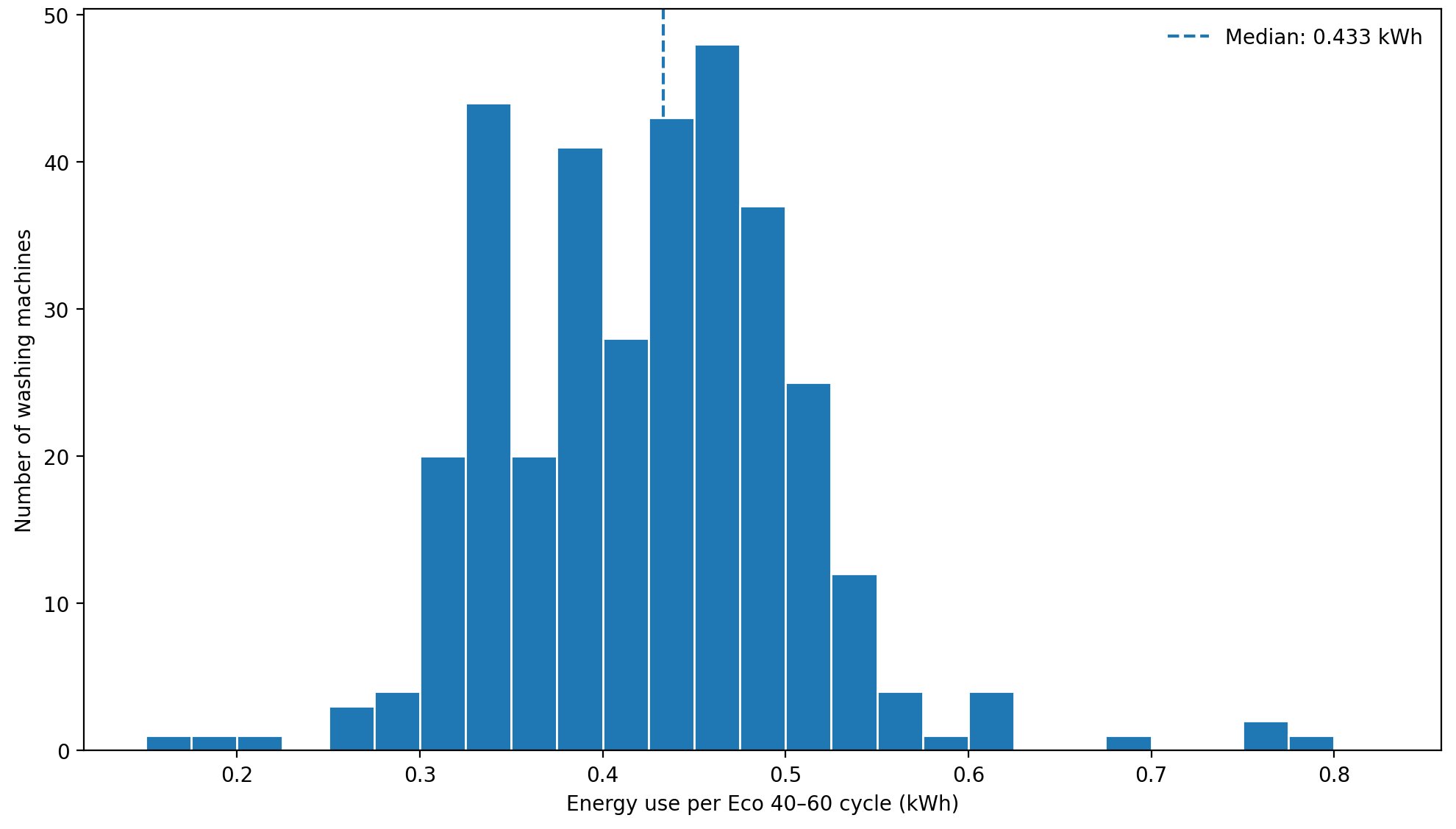
Different machines can also vary greatly in energy efficiency. For example, the energy use per cycle quoted for the Samsung WF90H09C4ST1 is just 0.173 kWh, whereas for the Indesit BIWMIL71252UKN it is 0.783 kWh. Most machines are in the 0.3-0.55 kWh range, as you can see in the chart below, which is based on 288 freestanding and 53 integrated machines.
Using an Energy Monitor
The only way to be 100% sure how much electricity your washing machine is using during the typical cycle is to use an energy monitor.
This is because there are a wide range of external factors that can influence the efficiency of an appliance that it just isn’t possible for manufacturers to take into account.
An energy monitor is simply a device that shows how much electricity is being used in your home at any given time.
If you are using a monitor that tracks your entire home, you can work out how much your washing machine is using by comparing the readings when the appliance isn’t running to when it is.
Alternatively, you can purchase monitors that you simply plug into the socket and then plug the washing machine into the monitor.
These can be purchased online and in a wide range of stores, but it is also worth reaching out to your energy provider to see if they have any offers.
Does the Energy Rating Matter?
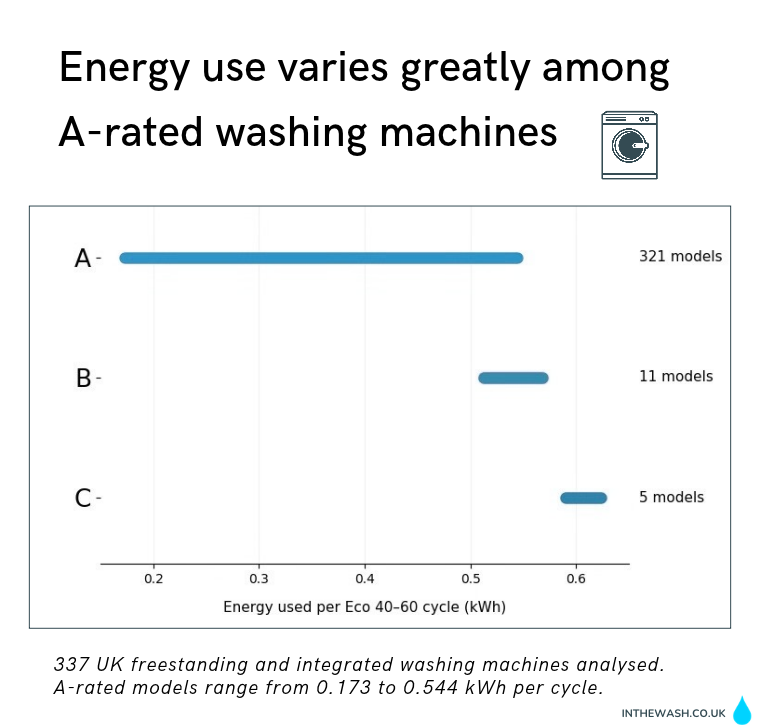
The energy class rating, which ranges from A-G is a useful shortcut for getting a rough idea of how energy efficient a washing machine is. However, the vast majority of washing machines on the market these days are A-rated, and there is a lot of variation across A-rated machines, as you can see in the chart below.
The energy class is based on energy usage on the Eco 40-60 programme, and adjusted based on the washing machine’s capacity, since larger capacity machines tend to use a bit more energy but can wash more clothes, so this doesn’t mean they are less energy efficient.
There are a few rare cases where one machine has a better energy rating than another despite using more energy. For example, the 10 kg capacity Bosch WGJ25400GB uses 0.514 kWh and has an A rating, whereas the 7 kg Beko BM3WT3741W uses 0.513 kWh per cycle (a bit less than the Bosch), and has a B rating. This is because the Bosch model is actually more energy efficient when you consider how much laundry you the 10 kg drum can handle per cycle.
Reducing energy usage
It is worth remembering that there are other ways that you can reduce the running cost of your washing machine.
As an example, if you wash your laundry on a 30-degree cycle, you can save as much as 40% electricity when compared to the typical 40-degree cycle.
Studies have shown too that modern washing machines and detergents are just as effective on lower temperatures as high ones, so you have nothing to lose!
Of course, it’s also important to consider other factors which may be more relevant than running costs, such as reliability, performance and longevity of a washing machine.
If you are considering a new machine, it’s worth checking out our list of the most energy efficient washing machines on the market if you want to minimise running costs.


In The Wash is your guide to the best laundry and cleaning products, tips and tricks. Our mission is to solve the UK’s cleaning and laundry dilemmas!