Water is the most precious resource on our planet, and it’s essential for human survival. But the fresh, clean water that we need isn’t an endless resource.
We’re now using fresh water supplies faster than ever before, so it makes sense for us all to do our best to try and reduce how much water we consume in our homes.
On a personal level, saving water also saves us money. Over 60% of UK homes now have a water meter installed, where customers are billed for the amount of water used.
Even if you don’t have a water meter, you will still pay local utility charges, and the greater the demand for water, the greater the price.
How Much Water Does a Washing Machine Use?
In the past, washing machines could use a staggering 150 litres of water per cycle – that’s almost as much water as most people now use in an entire day (146 litres according to Statista).
The good news is that this has reduced significantly due to advances in technology in the last 20 years.
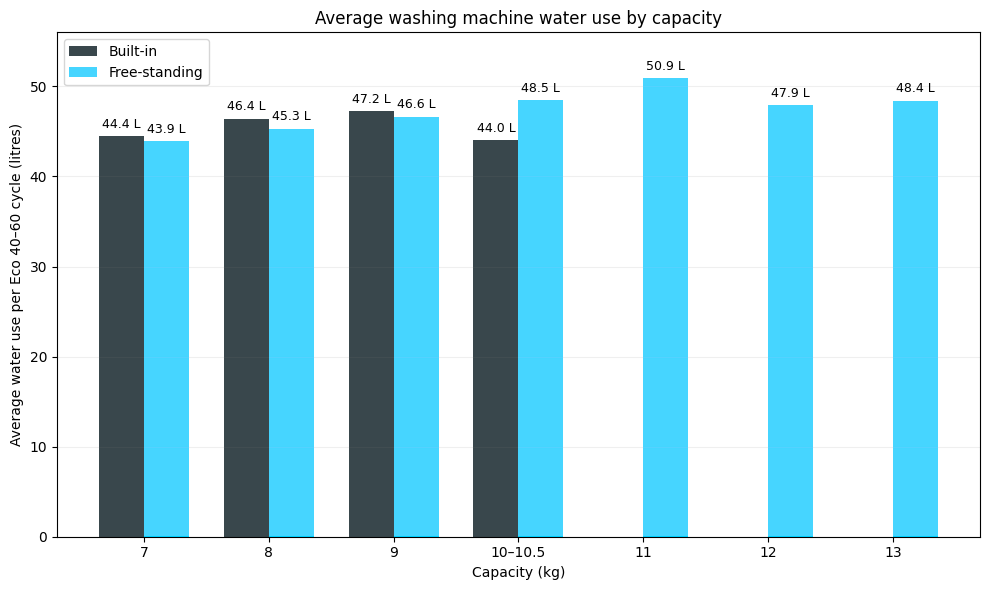
We looked at 341 washing machines on the market in the UK, and found that the average washing machine uses 47.3 litres per cycle.
The number varies slightly between integrated and freestanding machines: Integrated machines use 46.2 litres per cycle on average, whereas freestanding machines use 47.5 litres on average. This can be explained partly by the fact that freestanding machines have larger capacities on average, which requires more water (but isn’t less efficient, since you’re washing more clothes).
As you can see in the chart below, machines with a bigger capacity tend to use a bit more water, though on average this is only an extra 0.77 litres per cycle for each extra kg of capacity.
Front Loader vs Top Loader Water Usage
Most washing machines on the market in the UK are front loaders, meaning the door is on the front of the machine.
In many countries, top loaders, which have the door on the top of the machine, are more popular.
Top loaders typically use more water than front loaders. According to American appliance brand Maytag, the average top-loading washing machine with an agitator uses 19 gallons (72 litres) of water per use, while the average high-efficiency top-loading washing machine uses 13 gallons (49 litres) of water per use.
We found that the average front loader uses 47.3 litres of water per use, which is less than both a high-efficiency top loader (49 litres) and a regular top loader (72 litres).
What’s the Most Water-Efficient Washing Machine in the UK?
The most water-efficient washing machine we could find is the ASKO Steel Seal™ W3096CW.UK which is a 9 kg freestanding machine that uses just 35 litres of water per cycle—more than 10 litres less than the average of 47.3 litres.
However, the ASKO W3096CW.UK is very expensive. A cheaper option that is almost as efficient is the Hisense 3S Series WF3S8043BB3, which uses just 36 litres of water in total per cycle. However, this model has a slightly smaller drum capacity (8 kg), so you can’t wash as much laundry at once.
Some machines may not appear particularly water-efficient at first, but are when you consider their capacity. For example, the Hoover Pro Wash Series 5 HBP 413BL8G-80 uses 45 litres of water per cycle (just under the average of 47.3 litres), but has a massive 13 kg drum capacity, so it can wash a lot more laundry than the average washing machine while using slightly less water.
Do Energy Ratings Reflect Water Usage?
Washing machine energy ratings are based solely on electricity usage, not water usage. Therefore, machines with better energy ratings don’t necessarily use less water. In fact, A-rated washing machines sometimes use more water than models rated B or below.
This can partly be explained by the fact that almost all freestanding washers on the market these days are A rated, and freestanding machines can have much larger capacities than integrated machines. Integrated washers are more likely to have energy ratings of B or below, and also tend to have smaller capacities, and hence often use less water.
How Else Can We Save Water When Doing Our Laundry?
In addition to switching to a more efficient machine that uses less water per cycle, you can also reduce water consumption by running fuller loads each time you do your laundry.
If you do need to only wash a few items, choose a half-load setting on your machine if one is available. This will ensure that only a necessary amount of water is used. If the items can wait for a full-sized load, then this is preferable.
Using your machine less often also helps to lower water consumption, saving you money and helping the planet.
Synthetic wash cycles tend to use more water to avoid creasing, so it may be worth using cotton wash cycles as much as possible and then grabbing the iron to do some manual crease control afterwards.
Finally, avoid using the extra rinse setting unless absolutely necessary.

In The Wash is your guide to the best laundry and cleaning products, tips and tricks. Our mission is to solve the UK’s cleaning and laundry dilemmas!