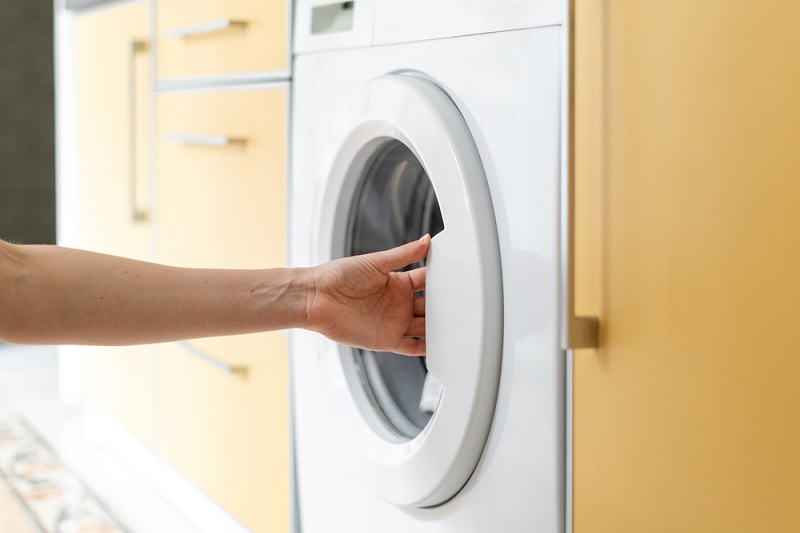
If you don’t like your appliances to be on show in the kitchen, or you’ve moved in to a place which is already built in, then an integrated washing machine is a really great option for you.
Integrated washing machines slot in between cupboards and also have a door on the front to keep your kitchen looking sleek.
Read on for picks of the top models available in the UK, or skip down to read some advice about choosing an integrated washing machine.
Our Top Picks
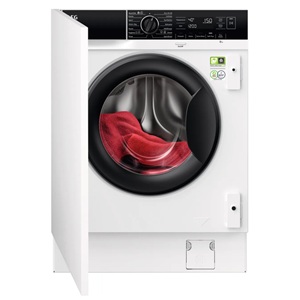
1. AEG OkoMix LF8E8436BI (Best Overall)
Why we picked it:
The AEG OkoMix LF8E8436BI is a bit pricey, but it’s very highly rated by users who praise it for its quietness, ease of use and flexibility.
What we like:
- Low water consumption (44 L/cycle compared to the median of 46 L/cycle for integrated machines)
- Relatively quiet (68 dB compared to the median of 72 dB for integrated machines)
- Short 20 minute Quick Wash setting
- Plenty of cycles and settings to choose from
Potential drawbacks:
- About twice as expensive as the average integrated washing machine
Check price and reviews:
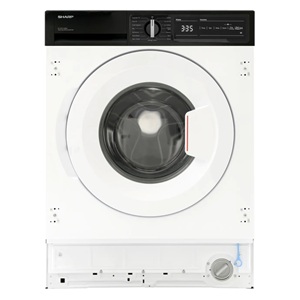
2. Sharp ES-NIH714BWA-EN (Best Budget Model)
Why we picked it:
The Sharp ES-NIH714BWA-EN isn’t quite the cheapest integrated washing machine on the market, but it’s reasonably priced and highly rated by users.
What we like:
- Affordable, with lots of positive user reviews
- Uses slightly less energy and water than the average integrated machine
Potential drawbacks:
- Capacity is a bit small at 7 kg
- A bit noisier than average on the spin cycle (74 dB compared to the median of 72 dB)
Check price and reviews:
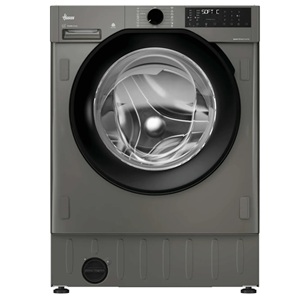
3. Hoover BH4S69M6DB9RJ-80 (Most Energy Efficient)
Why we picked it:
At 0.346 kWh/cycle, the Hoover BH4S69M6DB9RJ-80 is the most energy-efficient integrated washers we could find (tied with a few similar models made by Hoover and its parent brand, Haier).
What we like:
- Uses just 0.346 kWh per cycle, about a quarter less than the median of 0.472 kWh for an integrated machine
- 9 kg capacity is relatively large for an integrated machine
Potential drawbacks:
- Some cycles take a long time
Check price and reviews:
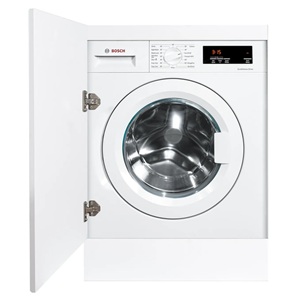
4. Bosch Series 6 WIW28302GB (Quietest)
Why we picked it:
At 66 dB on the spin cycle, the Bosch Series 6 WIW28302GB is the joint-quietest integrated model we could find, along with the NEFF W543BX2GB, NEFF W544BX2GB and Siemens WI14W502GB, but has picked up more positive reviews on retailer websites at the time of writing.
What we like:
- Makes 66 decibels of noise on the spin cycle, which is significantly less than the median of 72 decibels for an integrated machine
- Uses less water than the average integrated washing machine
Potential drawbacks:
- Higher energy usage per cycle compared to other models. Energy rating is C (most integrated machines have an energy rating of A)
- Relatively expensive
Check price and reviews:
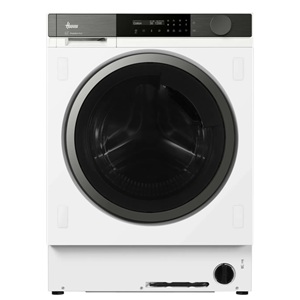
5. Hoover H-Wash 600 HBSI 410CIL8U-80 (Largest Capacity)
Why we picked it:
This model from Hoover has a capacity of 10 kg, which is the largest we could find for an integrated washing machine (most have a capacity of 8 or 9 kg). It’s also well rated by users, and cheaper than many smaller-capacity alternatives.
What we like:
- Low water consumption despite the large capacity (44 L/cycle compared to the median of 46/L cycle for integrated washers)
- Relatively quiet at 68 dB on the spin cycle
- Relatively compact (53 cm deep), despite the large capacity
- Low energy usage (0.41 kWh/cycle compared to the median of 0.47 kWh/cycle for integrated washers)
Potential drawbacks:
- User reviews are positive, but ratings are slightly lower than some alternatives
Check price and reviews:
Integrated Washing Machines at a Glance
Here’s an overview of the integrated washing machine market in the UK at the time of writing:
| Metric | Average | Median | Range |
|---|---|---|---|
| Price | £461 | £399 | £269–£839 |
| Capacity | 8.3 kg | 8 kg | 7–10 kg |
| Energy use | 0.486 kWh/cycle | 0.472 kWh/cycle | 0.346–0.783 kWh/cycle |
| Water use | 46.2 L/cycle | 46 L/cycle | 44–62 L/cycle |
| Spin noise | 71.1 dB | 72 dB | 66–76 dB |
| Depth | 54.8 cm | 55 cm | 53–64 cm |
How to Choose an Integrated Washing Machine
What is an integrated washing machine?
Integrated washing machines are designed to be positioned in a kitchen or laundry room unit and covered by a door panel. This means that the washing machine is integrated into the room, helping the room look tidier.
Integrated vs freestanding washing machines
Most washing machines sold in the UK are freestanding rather than integrated. There are pros and cons to each type of washing machine.
Integrated washing machines have less capacity on average, so if you need a particularly large amount of capacity you will probably be better off with a freestanding machine.
On the plus side, integrated washing machines can be hidden away, making your kitchen or laundry room look tidier and smarter.
One downside with integrated washing machines is that they are more expensive than their freestanding counterparts. This is because they are manufactured in smaller quantities rather than because they are higher quality, so if you want to get the most amount of performance for your money, a freestanding machine might be better.
The sides and top of freestanding washing machines usually have smooth white finishes, whereas on integrated machines they are typically unfinished. The front of integrated models will also be more basic. This doesn’t matter though because you won’t actually see the top and sides when the washing machine is installed, and you will only see the front when you’re actually using the washing machine.
Can you replace an integrated washing machine with a freestanding one?
Many people ask the question, “Why can’t I just replace my old integrated washing machine with a freestanding one?” While this might seem like a simple thing to do, there are a few issues if you try to do this:
- Freestanding machines are usually taller, and might not fit in your cabinet
- Integrated washing machines have space for a plinth (the bit that runs along the bottom). Freestanding machines don’t have space here, so they might not fit your cabinet properly.
What to look for in an integrated washing machine
- Good energy efficiency rating: Most integrated machines these days have an energy efficiency rating of A, though some have a rating of B or lower.
- Good value for money: Integrated washing machines range in price from under £300 to over £800. Look for one that combines an affordable price with good features, high build quality and reliable performance.
- Dimensions: For obvious reasons, one of the most important things when buying an integrated washing machine is making sure it will fit in your cabinet.
- Good capacity: A washing machine’s capacity determines how much washing you can do at once. If you have a family of four, you’ll want a capacity of about 8-9 kg.
Integrated Washing Machine FAQs
How long do integrated washing machines last?
There are a range of factors that can influence how long a new washing machine will last, and that applies to both integrated and freestanding washing machines.
Factors such as the specifications, price, brand and functions are all things that you should consider when choosing the best washing machine for you, as all of these things can have an impact on how long a washing machine is likely to last. To make this decision, consult not only the manufacturer’s own information, but reviews from users too.
Average lifespan
At one point or another, most of us will hear someone bragging that their washing machine has lasted 10, 20 or even 30 years. However, most of us can expect that a new washing machine will last around six years before we consider replacing it.
Manufacturer guidelines
Many manufacturers do now publish guidelines on how long they expect their washing machines to last, based on their own testing.
Indesit, for example, have quoted some of their appliances as being expected to last around 7 to 8 years, and other brands such as Miele test their appliances to the equivalent of 20 years use.
It is worth remembering, however, that even these expected lifespans from the manufacturer may not be accurate in certain circumstances.
Factors such as where the washing machine is installed, if it is regularly under or overloaded, how often it is used and how much detergent is added to each cycle can all influence the lifespan of a washing machine.
Do integrated washing machines need a cabinet?
Unlike many ovens or integrated fridges, integrated washing machines do not need a full cabinet. They usually sit directly on the floor just in between two cabinets, a cabinet and an end panel or a cabinet and the wall for support.
These washing machines then just need a cabinet door to be attached to the front; this can be hinged in either direction depending on your kitchen.
Can you integrate a normal washing machine?
Technically you can put a regular freestanding washing machine in a cabinet in the kitchen, but you will need to make sure the cavity is deeper than a normal space for an integrated machine as freestanding washing machines are larger.
To make it fit and sit flush with the remainder of your cabinets, you would need to either make the cabinets deeper, or pull them away from the wall, creating a larger gap behind them. It can be done, but for many people, it is probably easier to just buy an integrated washing machine.

In The Wash is your guide to the best laundry and cleaning products, tips and tricks. Our mission is to solve the UK’s cleaning and laundry dilemmas!