Condenser tumble dryers work by condensing warm damp air from clothes inside the drum into water, which is then deposited into a container to be emptied once drying has finished.
This means they can be located almost anywhere in a house or flat, as unlike vented dryers, they don’t rely on connecting a hose to a vent or window.
There are many condenser tumble dryers available to buy right now, from budget buys to high-end, more expensive models that use modern technology and features.
Best Condenser Tumble Dryers in the UK
1. Beko DTBC10001W

Load capacity: 10 kg
Dimensions: 84.6 x 59.7 x 63.3 cm
Energy rating: B
Annual energy consumption (estimate): 670 kWh
The Beko DTBC10001W is a straightforward condenser dryer with a no-nonsense design. Its generous 10 kg load capacity makes it a good choice for larger families and households with plenty of washing.
This dryer has a noise level of 66 decibels, which makes it a fairly typical tumble dryer in terms of noise.
The Beko DTBC10001W has a range of 15 drying programmes, ranging from a 10-minute timed programme to longer programmes like “Cottons Cupboard Dry”, which takes 165 minutes for a full load.
The sensor drying feature automatically monitors the moisture level of your laundry, so the machine can stop when your clothes reach the selected dryness level rather than running for longer than necessary.
With an energy rating of B and an estimated annual energy consumption of 670 kWh, this is a relatively energy-hungry tumble dryer compared with modern heat pump models, although its sensor drying feature can help avoid wasting electricity.
This is a popular and highly rated condenser dryer that would be a great choice for larger households looking for a spacious, straightforward machine.
2. Hotpoint C HD C92 WWGD UK

Load capacity: 9 kg
Dimensions: 84.6 x 59.7 x 60.1 cm
Energy rating: B
Annual energy consumption (estimate): 617 kWh
The Hotpoint C HD C92 WWGD UK is a mid-priced condenser dryer with a generous 9 kg capacity that should be enough for a family of four.
One nice thing about this dryer is that the water tank is at the top of the machine, which makes it easier to empty. You don’t have to bend down to access the water tank like you do with most condenser dryers.
There are 15 drying programmes to choose from, including a Rapid Cycle that can dry an outfit in just 14 minutes.
The dryer will automatically detect when your clothes are dry and switch off, saving you money on your electricity bills and preventing clothes from coming out stiff and overly dry.
Most users find this dryer to be very easy to use and efficient. It’s an especially good option for those who find it hard to bend down, since you don’t need to bend down to access the water tank.
3. Indesit C YD C82 WWGL UK
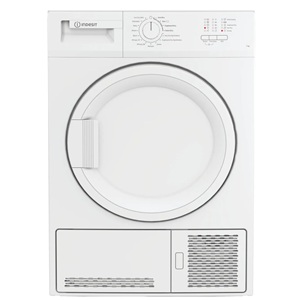
Load capacity: 8 kg
Dimensions: 84.6 cm high x 59.7 cm wide x 56.8 cm deep
Energy rating: B
Annual energy consumption (estimate): 562 kWh
The Indesit C YD C82 WWGL UK is a cleverly designed dryer that offers a good selection of programmes to suit different fabrics, helping to dry your clothes without causing unnecessary wear and tear.
Like other condenser dryers, this model collects moisture in a removable water tank rather than needing an external vent. The tank is easy to empty, making the dryer convenient to use in different areas of the home.
There’s a good selection of 15 programmes to choose from, including Delicates, Synthetics and Refresh. It also has a Smart Iron feature that uses warm air to help reduce creasing, making clothes easier to iron afterwards.
Most people find that this dryer works very well, but some loads may need a little extra drying time, especially when using gentler settings. You should be able to fix this by experimenting with different programmes, or using the sensor drying feature to help achieve the level of dryness you need.
4. Sharp KD-NCB8S7GW91-EN

Load capacity: 8 kg
Dimensions: 84.5 x 59.6 x 56.3 cm
Energy rating: B
Annual energy consumption (estimate): 561 kWh
The Sharp KD-NCB8S7GW91-EN is a modestly priced dryer that uses sensors to detect when your clothes are dry and then automatically switch off, saving energy and preventing over-drying.
The “Bubble Drum” design helps stop clothes from sticking to the drum. The reverse action tumbling also helps clothes dry evenly and prevents them tangling and clumping into a ball.
Most people find that this dryer is easy to use, and dries clothes quickly without being too noisy. It doesn’t feature WiFi connectivity so you can’t control it via an app, but that could be a good thing if you’re not keen on “smart” appliances!
5. Candy Smart CSEC9DF

Load capacity: 9 kg
Dimensions: 85 x 60 x 60 cm
Energy rating: B
Annual energy consumption (estimate): 670 kWh
The Candy Smart CSEC9DF has a 9 kg capacity, so it’s a good choice for families and larger households.
It can be connected to your smartphone or tablet to control the start time and programme remotely, though most people find this is unnecessary! If you really want to control the dryer from a phone or tablet, you will need the Candy simply-fi app.
Like most modern tumble dryers, the Candy Smart CSEC9DF uses sensors in the drum to detect how moist your clothes are and automatically adjust the cycle time, thereby saving energy and cutting the cycle time.
Most people find that this dryer dries clothes very quickly, is easy to use and has a smart-looking design.
The most common complaint is that the outside of the appliance can get hot, which can be quite worrying.
6. Hoover H-DRY 350 HRE C9TBE-80

Load capacity: 9 kg
Dimensions: 85 x 59.6 x 59.5 cm
Energy rating: B
Annual energy consumption (estimate): Kwh
Hoover might be best known for their vacuum cleaners, but they make some pretty great tumble dryers as well!
The Hoover H-DRY 350 HRE C9TBE-80 has a generous 9 kg capacity, making it a good choice for larger households and people who need to be able to dry a lot of laundry at once. The big drum size means you can dry large items like duvets.
The dryer uses sensors so that it will stop the cycle as soon as your laundry is dry, saving you money on electricity costs.
This dryer is easy to use and can be connected to your phone via an app which helps you choose the right cycle. You can even scan a clothing care tag and it will recommend which settings to use! The app also gives you access to more than 40 additional cycles which can be customised and saved.
This dryer is very highly rated, and quite affordable when compared to heat pump models, especially given its smart features.
7. AEG T6DBG720N 7Kg Condenser Tumble Dryer

Load capacity: 7 kg
Dimensions: 85 cm high x 60 cm wide x 60 cm deep
Energy rating: B
Annual energy consumption (estimate): 503.5 kWh
The AEG T6DBG720N is a cleverly designed dryer that is gentle on clothes, meaning it’s unlikely to shrink or damage your laundry.
Unlike most condenser dryers where the water tank is at the bottom, in this model the tank is at the top, making it easier to access and empty.
There’s a good selection of programmes to choose from including Delicates, Anti Crease and Synthetics.
Most people find that this dryer works very well, but it can leave clothes slightly damp, especially when using Eco mode. You should be able to fix this by experimenting with different settings, or drying clothes for a few extra minutes if necessary.
How Do Condenser Dryers Work?
Many of us rely on our tumble dryers to help us dry our laundry, especially when we haven’t got the time, space or good enough weather to dry our clothes outside.
Traditional dryers require a vent to remove the damp air through a hose and out of an open window, or through a vent installed via an outside wall.
However, it’s not always possible or practical to install a vented dryer, particularly in a small house or flat.
Condenser dryers don’t need venting so can be installed almost anywhere, making them a good alternative for when a vented dryer isn’t suitable.
Condenser tumble dryers remove humidity from wet laundry in quite a different way to vented dryers.
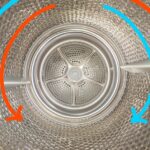
In a condenser dryer, there are two separate airflows. The inside airflow is sealed within the drum of the dryer.
This is re-circulated inside the machine and heated, and as the airflow passes through the damp clothes, it collects moisture.
The damp air is diverted into a heat exchanger in one direction, as air from the outside room passes through the condenser in the opposite direction.
As the air is then condensed back into water and is emptied through a hose or into a plastic tank.
Below is a super quick video which shows how condenser dryers work with diagrams:
Condenser Dryer Glossary
Here are some common technical terms you may come across when choosing a condenser tumble dryer.
Load capacity
This refers to the weight of laundry you can put in the dryer, not the weight of the dryer itself.
It refers to the dry weight of clothes (how heavy they are when you take them out of the dryer). This means that if you have an 8 kg washing machine, an 8 kg tumble dryer would be a good choice.
Energy rating
This refers to how energy efficient the machine is. A more energy-efficient model will be better for the environment and also mean you’ll pay less in energy bills. Tumble dryers are known for being expensive to run, so the energy rating is important.
The most common energy rating for a condenser dryer is B.
The most energy-efficient tumble dryers are heat pump dryers rather than condenser dryers. Heat pump models can have the highest possible energy rating of A+++.
Reverse action
This means that the drum spins in both directions, which dries laundry more evenly using less energy and with less creasing.
Sensor drying
If your tumble dryer has sensor drying, this means that there are sensors in the drum that will detect when your laundry is dry and then stop the cycle. This saves energy and therefore money.
Delay start timer
A delay start timer allows you to program the dryer to start after a certain period of time. This can be useful, but isn’t always recommended as programming the dryer to start when you’re in bed or out of the house could be dangerous.
Tumble dryers can catch fire, so it’s better to use the tumble dryer while you’re awake and at home just in case.
Installing and Using a Condenser Dryer
Although condenser dryers can be fitted almost anywhere, it’s ideal to fit your dryer in a well-ventilated room that allows some of the warm air to escape.
Condenser dryers can raise the temperature of a room, which might save on heating bills but can cause condensation problems on cold surfaces such as windows.
If your condenser dryer has a water tank rather than a hose, it will need to be emptied after each drying cycle as once the tank is full the machine will interrupt the cycle.
You should remove the fluff and debris from the heat exchanger four or five times a year to keep the dryer working effectively.
Condenser drying capability is sometimes built into washing machines, creating washer/dryer combination appliances which have the advantage of being able to dry straight after washing, so you can do your wash and dry immediately without the need to move the clothes across.
These appliances can also save space rather than having a separate washing machine and tumble dryer in small houses and flats. However, there are some drawbacks to washer dryers – this article weighs up the pros and cons.

Tumble Dryer FAQs
Here are some of the most frequently asked questions about tumble dryers.
Are tumble dryers safe? Can they catch fire?
Occasionally, tumble dryers can catch fire and there have been issues with particular models in the past.
In 2019, a fire safety notice was been issued for several models made by Whirlpool, who discovered that their tumble dryers could set on fire when fluff built up and came into contact with the heating element.
Switching the tumble dryer off at the wall when you’re not using it is always a good idea. However, there have been horror stories of some tumble dryers catching fire despite being turned off, so you definitely need to be careful to buy a tumble dryer with a flawless safety record.
We’ve written an in-depth article on which tumble dryers are the safest here.
Do tumble dryers turn off automatically?
Yes, almost all tumble dryers turn themselves off automatically once they’re done. You should check the instructions manual for specific details about how your machine works.
Do tumble dryer sheets work?
Tumble dryer sheets are small sheets of material treated with fabric softener that prevent clothes from picking up static while also softening them and helping them smell nice.
They are usually effective at reducing static and giving your clothes a nice smell, but many contain harmful chemicals and allergens.
Some manufacturers produce fragrance-free and organic tumble dryer sheets for people with sensitive skin or environmental concerns.
Do tumble dryers cause damp?
Vented tumble dryers that aren’t vented properly can cause substantial amounts of damp. They will pump out a lot of moisture, causing condensation and damp.
Condenser tumble dryers are much better than vented dryers if you want to avoid damp, as they store the moisture in a bottle which you can empty down the drain.
However, condenser tumble dryers aren’t always 100% efficient, so they might contribute partially to damp.
Can tumble dryers shrink clothes?
If you’re not careful, using a tumble dryer could shrink your clothes. To prevent this from happening, wash and dry your clothes at a low temperature.
Using too much heat is the main culprit when it comes to shrinking.
Carefully check the care label on your clothes before washing and tumble drying them to make sure they can be safely machine washed and dried.
Can tumble dryers be used in the garage?
You can put your tumble dryer in the garage if it is warm enough, but you shouldn’t if your garage gets very cold in the winter.
If it’s too cold, the dryer might stop working and it might not be covered by the warranty. If you heat your garage this shouldn’t be a problem, but it’s generally not advised to put a tumble dryer in the garage if it gets very cold.
A cold garage combined with a condensation-producing tumble dryer is also a recipe for rusty tools and damp, so if you’re using a vented tumble dryer, make sure it’s vented properly so the moisture is being pumped outside and not into the garage itself.
Are tumble dryers expensive to run?
The cost of running different tumble dryers varies depending on how efficient the dryer is and how you use it. To get an idea of how cheap a tumble dry will be to run, look at the energy efficiency rating.
A dryer with an ‘A’ rating will cost about half as much to run as a dryer with a ‘C’ rating.
The most energy-efficient dryers are heat pump dryers, which typically cost around £30 a year to run at the time of writing.
However, if you buy a standard condenser tumble dryer, you will probably pay closer to £80 a year in electricity costs.
To keep your costs to a minimum, look for a dryer with a good energy efficiency rating (no worse than ‘B’) and smart features such as sensor drying, which switches the dryer off as soon as your clothes are dry.
You can also part-dry your clothes and then finish them off with air drying to save more money, or consider choosing a heated airer instead.
How heavy is a tumble dryer?
The lightest tumble dryers weigh around 15 kg, but a regular tumble dryer will usually weigh around 25-30 kg.
Will tumble drying kill fleas and bed bugs?
Tumble dryers usually won’t kill fleas and bed bugs unless you use the hot setting for over 30 minutes.
However, this might not be a good idea as you could shrink or damage your clothes by using the hottest setting.
Condenser vs Vented Tumble Dryers
Tumble dryers are super handy if you have space in the kitchen or in your laundry room. It’s not always suitable to dry your washing on the line outside and it’s not great drying your clothes on radiators or hanging them indoors.
This is where tumble dryers come in; they take your washing from wet to dry, fluff towels and warm your clothes so you can pop cosy clean clothes on straight away!
Once you’ve decided you’d like a tumble dryer in your life, then you have to decide which type works best for your home: vented or condenser? If you’re wondering what those two words mean, then read on and we’ll help you out.
Vented

A vented tumble dryer is the original design of this helpful appliance, with a hose which needs to be placed out of a window, door or purpose-built vent.
The hose removes hot, damp air out of the machine and out of the house.
Without the hose, there would just be a hole, which would mean a lot of condensation in the home.
Pros
- Tend to use less electricity
- Usually a little cheaper to purchase
- More reliable than condenser dryers
- Easier to fix as parts are readily available and simpler to fit etc.
- Simple to use
- Available to buy in multiple drum capacities
Cons
- Can be difficult to find a suitable place for easy venting
- May require putting a vent hole into the wall
- If using an open window or door for venting it would be cold in the winter
- The hose can be prone to wearing or splitting
- The filter needs to be cleaned regularly or built up fluff/dust can become a fire hazard
Condenser
A condenser tumble dryer doesn’t need a hose to remove condensation. Instead, it condenses the liquid into a removable container which can be emptied relatively easily.
Some dryers can be plumbed in so that the water is removed automatically without the need to empty the chamber.
Pros
- The collected water can be used to water plants so it isn’t wasted
- Can be placed anywhere
- More features than a vented dryer
- Some machines stop when the sensor picks up that the load is dry; saving energy
- Great if you end up moving to a house which could not have a vented model
- Available to buy in multiple drum capacities
Cons
- The condenser chamber is heavy when full of water
- Should be emptied after each load
- Costs more than vented
- Costly to fix
- Replacement parts aren’t as readily available (for repairs)
- Multiple filters to clean regularly, with some harder to find than others
- Cheaper models may still let moisture out into the air, causing damp or mould in your home
Conclusion
If we had to pick just one condenser tumble dryer to recommend to most people in the UK it would be the Beko DTBC10001W. While it isn’t the most advanced product, it’s well priced, easy to use and has a good drum size. It gets the job done and dries clothes well while being easy to clean and maintain.


In The Wash is your guide to the best laundry and cleaning products, tips and tricks. Our mission is to solve the UK’s cleaning and laundry dilemmas!